

Community Voice & Research
Art is how communities express who they are

Some questions can’t be answered with a survey.
The experience of living in a neighbourhood, navigating a health system, belonging to a community. This kind of knowledge is complex, embodied, and often impossible to articulate in words alone.
These projects use art-making as a form of inquiry.
Participants don’t just answer questions — they paint their answers. They make them visible. The process surfaces insight that organisations need to do their work well and gives communities something they need even more: the experience of being genuinely heard.
City of Guelph
What is Care
70 participants in Guelph investigate community recovery post-pandemic.
Egale
Sensitive Dialogues
LGBTQ+ older adults and homecare workers foster dialogues for insight.
City of London
Pandemic Chaos
130 people document a dozen concepts relevant to 2020 global lockdowns.
Muslim Resource Center
Stories of Hope
Syrian youth reflect on home and land while sharing their migration story,

Art as inquiry
Conventional research methods ask communities what they think. These projects ask communities to show what they know — and in the act of making it visible, produce something no focus group can replicate.
Images reach where words don’t. When a person paints their experience of a health system, a neighbourhood, a social issue — they produce qualitative data that is specific, emotionally accurate, and already translated into something other people can understand. That’s the power of image as a universal language.
The facilitation process is designed to build trust alongside insight. Participants feel heard because they are heard — and what they create together becomes the evidence.
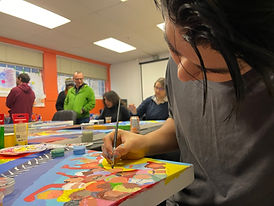

How it works:
Each project is shaped around a question your organisation is sitting with. What does your community actually know that you don’t? What lived experiences need to be visible before meaningful action can happen? What stories are being missed by your current data?
Participants engage in structured creative sessions where art-making, storytelling, and facilitated conversation work together. Sessions can be adapted for community centres, health settings, public spaces, research contexts, or events.
The result is a body of collective visual work — and the insight woven through every image.
What it generates:
-
Qualitative depth that goes beyond what conventional research methods surface
-
A body of community-authored visual work that can be exhibited, published, or shared
-
Insight that is already in a form communities recognise and claim as their own
-
Trust — because the process of being genuinely heard builds it, in ways that surveys don’t
